
The general journal is the repository for transactions that are not recorded in a specialty journal. Thus, the general journal can be considered an intermediate repository of information for some types of information, on the way to its final recordation in the general ledger. Sometimes, the general journal is called the book of original entries. This is because all of this book initially records all of the business’s financial transactions before moving into other books.
General journal entries examples
Likewise, there is also no journal entry required to be recorded when Mr. A hired an assistant photographer on March 6 since the employee has yet to render a service for the business. No form of compensation was also paid to require recording the transaction. In this example, any form of payroll and sales taxes will be disregarded to simplify recording of transactions. Below are the journal entries for each transaction during March 2023 and how they are recorded in the general journal. Below is an illustrative example involving several common business transactions and how to record them in the general journal.
Double Entry Bookkeeping
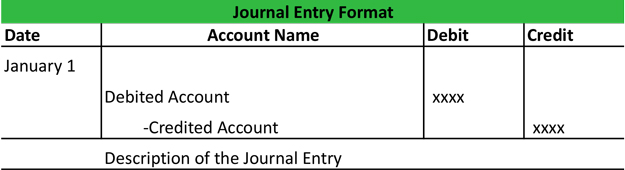
Each journal entry is also accompanied by the transaction date, title, and description of the event. Here is an example of how the vehicle purchase would be recorded. These entries are made in the order that the transactions occurred. General journals typically contain information about things like cash receipts and payments. In addition, they can also contain inventory balances, purchases and sales. All journal entries are posted periodically to the ledger accounts.
How much will you need each month during retirement?
When an event occurs that must be recorded, it is called a transaction, and may be recorded in a specialty journal or in the general journal. There are four specialty journals, which are so named because specific types of routine transactions are recorded in them. These journals are the sales journal, cash receipts journal, purchases journal, and cash disbursements journal. Instead, by default, all remaining transactions are recorded in the general journal.
The purpose of a general journal
The journal entry is an essential component of the double-entry bookkeeping system. It is the tool that you’ll always be using to enter the details of the transaction as inputs in the accounting system. Examples of transactions recorded in the general journal are asset sales, depreciation, interest income and interest expense, and stock sales and repurchases. There are many special journals, and the four common types of special journals that normally use are Sales Journal, Purchase Journal, Cash Receipts Journal, and Cash Payments Journal.
- In addition to the general journal, there are several special journals or subsidiary journals that are used to help divide and organize business transactions.
- In addition, they can also contain inventory balances, purchases and sales.
- Journalizing or Booking is the process of recording business transactions in the journal.
- He has worked as an accountant and consultant for more than 25 years and has built financial models for all types of industries.
FAR CPA Practice Questions: Calculating Interest Expense for Bonds Payable
Thus, the general journal is an intermediate repository of information for some types of transaction, on the way to its final recordation in the general ledger. In summary, we record a transaction into a journal and then post the information in the journal to the respective accounts which are in the general ledger. Therefore, by default, we record all remaining transactions in the general journal. Again, the company received cash so we increase it by debiting Cash. We will record it by crediting the liability account – Loans Payable.
In the journal, two aspects of every transaction are recorded, following the double-entry system of accounting. With a combination journal, only the total amounts of each column are posted in the general ledger, thus saving a lot of time and effort. The entries in the sundry column can be posted individually to the general ledger. Journalizing or Booking is the process of recording business transactions in the journal.
Hopefully this article clears up any questions you have regarding general journals. You’ll learn what a general journal is for, how to complete an entry in a general journal, and more. Companies use many different journals depending on their accounting system and industry, but all companies use the general journal. It is worth noting that the receivables and payables accounts must be posted twice.
The first book in which transactions are recorded is called the general journal. Transactions are recorded in chronological order (i.e., the how can i change the language setting to spanish order of their occurrence). The first step is transaction analysis, which provides the information needed to journalize a transaction.
For instance, a description for a general journal may be written as ‘To record equipment purchase‘ or ‘To record inventory payment’. Other journals like the sales journal and cash disbursements journal are also used the help management organize and analyze accounting information. Throughout the accounting period, a business enters into transactions with customers, vendors, suppliers, the government, and other entities.
A well-designed accounting system can contribute to the timely and efficient preparation of financial statements. Whether you use physical books of account or an accounting software, you must ensure that it suits the particular needs of your business. Notice that the combination journal includes a miscellaneous column. This column, which is also referred to as a sundry column, is where you’ll be listing the accounts of transactions that occur less frequently. Recording transactions can be time consuming that’s why using technologies such as accounting software and POS machines could result in easier and more streamlined data entry.